Flexible filament has always been the material people want and then avoid. Soft TPU buckles in the extruder, prints slowly and strings, so most makers stick to the familiar 95A grade or give up on soft parts altogether. In the last four weeks, three launches changed that picture: Bambu Lab's ultra-soft TPU 75A on 2.85 mm filament, a new wave of high-rebound TPE and TPU grades, and Polymaker's G-Flex PETG, a PETG/TPU blend that prints like a rigid filament. Here is what each one does, what it needs, and how to pick the right one for your part.
▶ Watch the video version (about 4 minutes):
Why soft filament has been hard to print
Flexible filaments are rated on the Shore A hardness scale: the lower the number, the softer the material. Most "TPU" sold for desktop printers is 95A, which feels like a firm phone case. Grades around 85A feel closer to a rubber band, and 75A is soft enough for straps, shoe insoles and grips that squash under a thumb.
The softer the filament, the harder it is to push. An extruder drives the strand from above into the melt zone; a soft 1.75 mm strand behaves like a wet noodle, bending and bunching up between the drive gear and the hotend instead of moving forward. That is why soft TPU has needed direct-drive extruders, tight filament paths and very low speeds, and why multi-material systems that feed filament through long tubes usually do not support it at all.
Three different answers to this problem arrived in October and November 2026.
Answer 1: thicker filament (Bambu Lab TPU 75A, 2.85 mm)
On November 3, Bambu Lab launched the H3C, a nine-tool tool changer priced at $2,499 in the US and €2,499 in the EU. Alongside the tool changer, its most unusual feature is the FlexFeed extruder, which accepts both 1.75 mm and 2.85 mm filament. According to Bambu Lab's buying guide, a cam-driven mechanism powered by a PMSM motor keeps the tension on the filament precise and consistent.
The idea is simple: a 2.85 mm strand is much stiffer than a 1.75 mm one, so it can take more push without buckling. Bambu Lab used that to release TPU 75A in 2.85 mm, which it rates at up to 10 mm³/s volumetric flow, roughly three times what a conventional 1.75 mm setup manages with such a soft grade. Press coverage of the launch in Forbes and heise quoted the company at up to five times the flow, so treat the exact multiplier as a vendor claim until independent tests appear.
The key facts:
- Price: $47.99 per 1 kg spool in ten colours, with launch sale pricing of $28.79.
- Hardware: H3C only, with the dedicated 2.85 mm hotend (0.4, 0.6 or 0.8 mm recommended). The H3C ships with eight 0.4 mm tools for 1.75 mm filament and one tool for 2.85 mm.
- Feeding: retailers' listings state that AMS, AMS lite, AMS 2 Pro and AMS HT are not compatible, and that the new AMS 3H needs a dedicated TPU feeding procedure.
- Data sheet values (published by Filament2Print): 200 °C nozzle, 30 °C bed, about 800 % elongation at break, 11.5 MPa tensile strength.
Bambu Lab's demo parts show where this fits: a printed shoe with soft 75A cushioning and a watch printed in one job with a soft TPU strap. The thicker format is also spreading: eSUN is preparing 2.85 mm TPU in 70A, 75A, 80A and 85A, with no launch date yet.
Who it is for: H3C owners who need truly soft parts, often combined with rigid materials in the same print. If you do not own an H3C, this spool will not help you; the 2.85 mm format is not compatible with Bambu's X, P or A series.
Answer 2: better elastic grades on standard 1.75 mm
The second trend works with the printer you already have. Material makers are reformulating flexible filament for more rebound and faster printing, still at 1.75 mm.
On October 21, eSUN announced TPE-95A, a thermoplastic elastomer with a rebound rate of up to 58 %. Compared with its conventional TPU-95A, eSUN claims up to 93 % more rebound, up to 137 % faster printing and nearly 30 % less abrasion, plus low compression set and toughness down to -30 °C. For Bambu Lab printers, eSUN suggests starting from the built-in TPU presets and tuning nozzle temperature and flow ratio.
A week later at WTCC Shanghai (October 22-25), Sundots launched a high-elasticity TPU 95A aimed at rebound closer to PEBA-type elastomers, a matte TPU 85A, a silk TPU 95A and TPE in 85A, 90A and 95A. Sundots itself says the PEBA comparison is a direction, not a replacement for the data sheet or a test print, which is a fair warning for this whole category.
A quick note on terms: TPE is the broad family of rubber-like thermoplastics; TPU is one specific type of TPE. Two filaments both labelled "95A" can still behave very differently in rebound, abrasion and how easily they feed.
Who it is for: anyone printing bumpers, phone cases, feet, gaskets, watch bands or cushioning on a direct-drive printer. A 95A grade with high rebound is the easiest upgrade: same hardness you already know how to print, livelier part.
Answer 3: tough, not soft (Polymaker G-Flex PETG)
Many "I need TPU" requests are really "I need a part that does not snap". That is the gap Polymaker's G-Flex PETG targets. It is a blend of PETG and TPU with a hardness of Shore 65D, which puts it between the two parents, and it launched globally at Formnext in Frankfurt (November 17-20).
Printing it is closer to PLA than to TPU:
- Up to 300 mm/s and 24 mm³/s flow, nozzle 230-240 °C, PEI bed 70 °C.
- Polymaker advises starting from a PLA or PLA Silk slicer profile.
- Tested with Bambu Lab AMS and AMS 2 Pro and with Creality CFS, so it can sit in a multi-material system next to rigid spools.
- Unnotched Charpy impact tests (ISO 179-1) recorded "No Break" in both XY and Z, the direction across the layers where printed parts usually fail first.
- Planned price $21.99 / €21.99 per kg; VOC verified and tested to EN 71-3 (a test standard, not a certification; not for mouth or food contact).
Polymaker is clear about the limits: at 65D it is not a substitute for soft TPU. Use it for clips, snap fits, brackets, toys and enclosures that get dropped, not for anything that needs to squash.
How the options compare
| Material | Hardness | Diameter | Printer needed | Best for |
|---|---|---|---|---|
| Bambu TPU 75A | 75A (very soft) | 2.85 mm | Bambu H3C + 2.85 mm hotend | Straps, insoles, soft grips |
| Standard TPU | 85A-95A | 1.75 mm | Direct drive, slow | Cases, bumpers, gaskets |
| High-rebound TPE/TPU 95A | 95A | 1.75 mm | Direct drive, TPU preset | Cushioning, springy parts |
| Polymaker G-Flex PETG | 65D (tough) | 1.75 mm | Most printers, AMS OK | Clips, toys, drop-prone parts |
A checklist before your first flexible print
- Decide what "flexible" means for the part. Must it squash (75A-85A), spring back (high-rebound 95A), or just survive impacts (G-Flex PETG)? This one decision removes most bad purchases.
- Check your feed path. Soft grades need a short, constrained path from drive gear to hotend. Bowden setups and most multi-material units are a poor fit; read your system's compatibility list first.
- Dry the spool. Flexible filaments absorb moisture, which shows up as stringing, bubbles and a rough surface. In humid places like Da Nang we dry every TPU spool before use and print from a dry box (see our guide to storing and drying filament in a humid climate).
- Start from the vendor preset, then tune one thing at a time: flow, temperature, speed. Keep retraction low.
- Design for the material. Soft parts need thicker walls than you expect; infill pattern and wall count change the feel as much as the filament does.
- Print a test coupon and squeeze it before committing to a 10-hour job. Hardness numbers alone do not tell you how a part feels.
Our take
At Lightning Lab we get a steady stream of requests for soft parts: grips for tools, protective feet, cable strain reliefs, cosplay pieces that need to bend. Most of them do not need 75A. A well-dried 95A TPU, or now a high-rebound 95A grade, covers the majority, and G-Flex PETG looks like a sensible default for brackets and clips that keep breaking in PETG or PLA.
The 2.85 mm move is the most interesting change, because it fixes the physics of the problem instead of asking users to print slower. But it is tied to one $2,499 printer for now, and the speed claims vary between Bambu's store page and press quotes. We will wait for independent tests and real-world spool availability in Vietnam before recommending it to customers. If you need a soft or impact-resistant part today, the 1.75 mm options above are ready to use.
Sources
- Bambu Lab: H3C announcement
- Bambu Lab: H3C buying guide
- Bambu Lab store: TPU 75A (2.85 mm)
- All3DP: Bambu Lab's new TPU 75A
- 3DPrinting.com: H3C launch and pricing
- Forbes: Bambu Lab's third-gen printer
- eSUN: TPE-95A press release
- Sundots: TPU and TPE launch at WTCC 2026
- 3DPrinting.com: Polymaker G-Flex PETG
- The 3D Printing Journal: China Watch #16
Need a soft grip, a gasket or an impact-proof bracket printed in Da Nang? Send your file or idea to lab@lightning-studio.org or visit Lightning Lab.
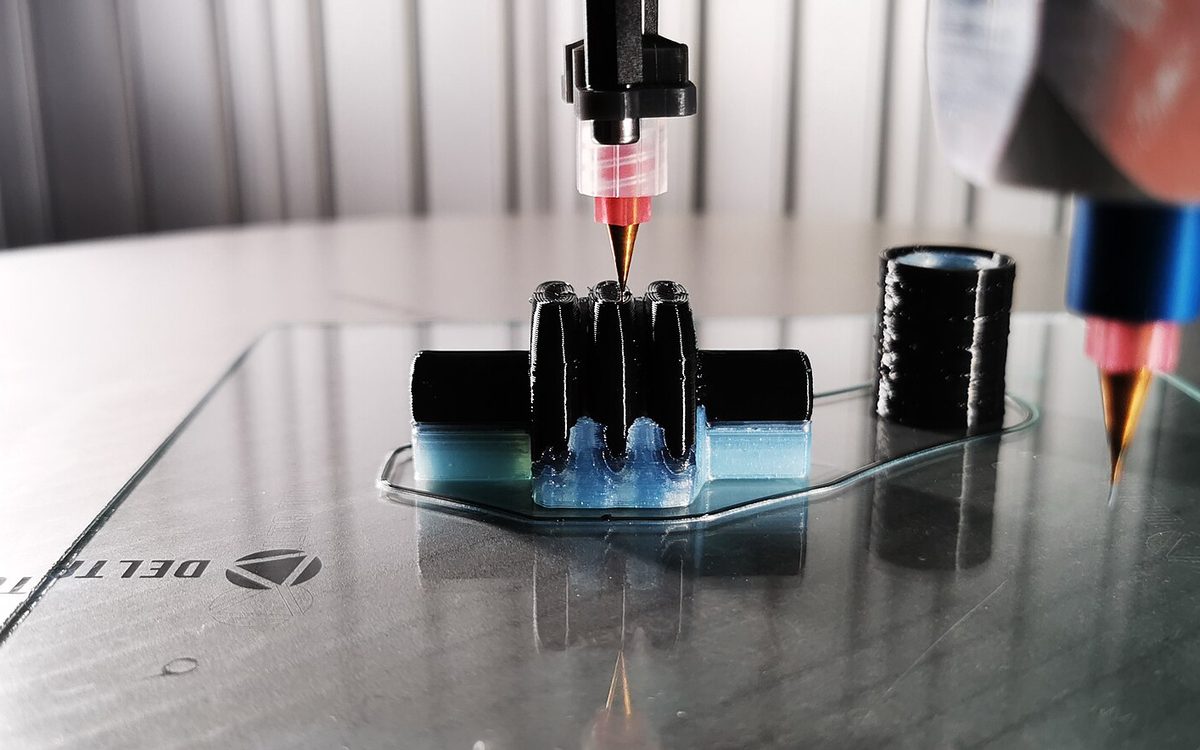
Cover photo: Silicone 3d print with support material by Obseus, CC BY-SA 4.0, via Wikimedia Commons (cropped).
Related posts
Pellet 3D Printing in 2026: When FGF Beats Filament
Prusa now sells pre-dried pellets in 4-14 kg packs and FGF printers start at $15,000. What pellet printing saves, what it costs you, and who should try it.
Prusa's Firmware Security Bulletin: Lock Down Your Networked Printer
Prusa disclosed 14 Buddy firmware flaws, with exploit code expected in December. Which printers are affected, how risky it is, and a checklist to update and secure any networked printer.
Filament Color Mixing: Dozens of Shades From Four or Five Spools
Bambu Studio, PrusaSlicer and Snapmaker Orca now blend thin layers of CMYW filament into new colors. How it works, which kit to buy and the settings that matter.