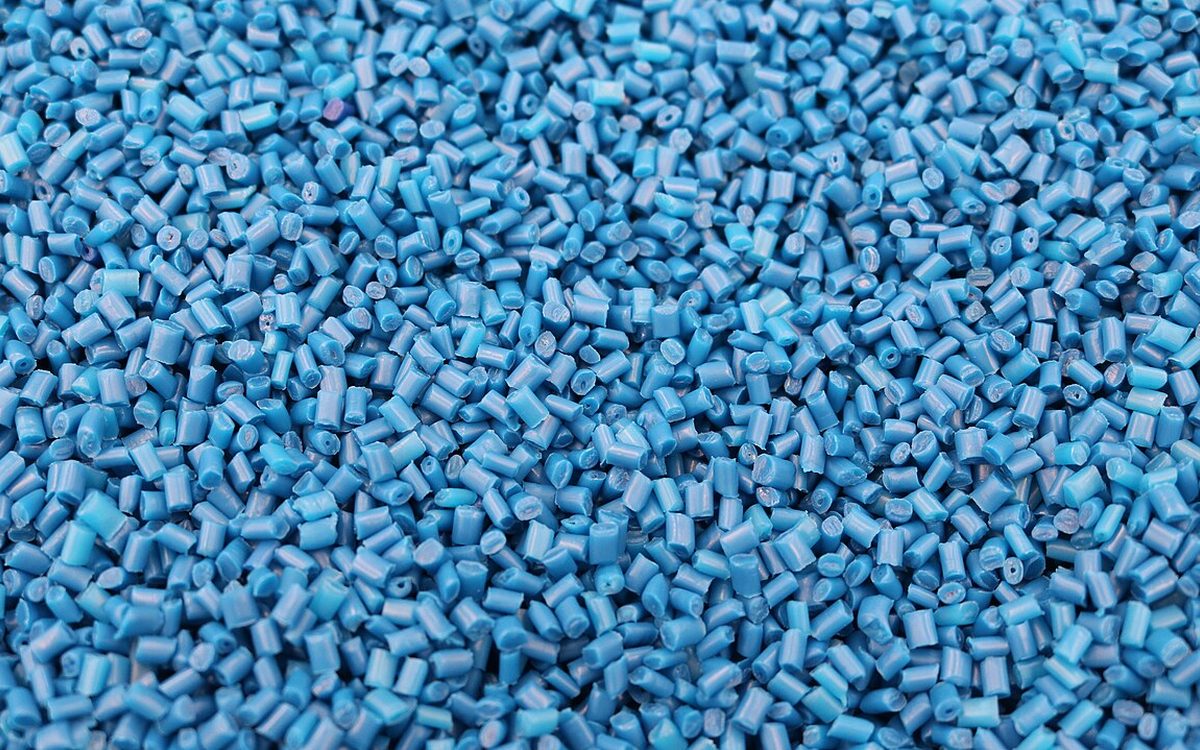
Plastic pellets are what every filament spool starts as, and until recently you could only buy them by the hundreds of kilos. In October 2026 Prusa Research started selling the same pre-dried pellets it turns into Prusament in 3.5 to 14 kg packs, Peopoly put its 800 mm pellet printer on regular sale, and Polymaker launched a pellet colour-mixing system. This guide explains how pellet printing (FGF) works, what it really saves, and when it is worth it for a workshop or lab.
▶ Watch the video version (about 4 minutes):
What happened in October 2026
Three announcements landed within a few weeks of each other:
- Prusament Pellets. On October 13, Prusa announced small-batch pellets in four natural (uncoloured) materials: PLA, PETG, ASA and PC Blend. Smaller packs come in 5-litre canisters, larger ones in sealed aluminium-plastic bags. Prusa says these are "the exact pellets we use for manufacturing Prusament", dried on arrival at its factory and sealed so they can usually be used straight from the pack.
- Peopoly Giga 800. First shown to early adopters in May, the Giga 800 is an 800 x 800 x 800 mm pellet printer that starts at $15,000 (EXW). 3Druck reported on October 29 that it is now on regular sale, with laser-assisted bed levelling added after more than 100 early-adopter sign-ups.
- Polymaker CymphoniK. Also on October 13, Polymaker introduced CymphoniK, six pellet SKUs (cyan, magenta, yellow, black, white and neutral) plus software that calculates mixing ratios. More than 100 colours are validated so far, starting with its PETG-1213 R50 material.
None of this turns pellet printing into a desktop hobby overnight. But it lowers two barriers that kept small teams out: buying material in small, clean, dry batches, and getting a machine that uses familiar software.
How pellet printing (FGF) works
FGF stands for Fused Granular (or Granulate) Fabrication. It is the same family of process as filament printing: plastic is melted and laid down line by line, layer by layer. The difference is where the melting happens. A filament printer receives plastic that someone already melted, drew into a precise 1.75 mm wire and wound on a spool. A pellet printer does that step itself.
The Ginger Additive FGF guide breaks the process into four steps:
- Drying. Many polymers absorb moisture from the air, and wet material hurts extrusion and surface quality.
- Feeding. Pellets travel from a container to a small hopper on the print head, often refilled automatically during long prints.
- Melting and extrusion. A rotating screw inside a heated barrel pushes the pellets forward, melts them and builds pressure toward the nozzle.
- Deposition. The slicer's toolpath is followed exactly as in filament printing.
Standard industrial pellets of about 3-5 mm are generally suitable, and because pellets are how plastics are sold to industry, far more grades exist as pellets than as filament, including fibre-reinforced and recycled compounds.
Pellets vs filament: the numbers
The two headline benefits are material cost and flow rate.
Cost. Prusa's launch prices (US prices include import duties; EU prices include VAT, as reported by 3D Printing Industry):
| Material | Small pack | Large pack | Price per kg |
|---|---|---|---|
| PLA Natural | 4 kg, $44.99 | 14 kg, $149.99 | $11.25 to $10.71 |
| PETG Natural | 4 kg, $44.99 | 14 kg, $134.99 | $11.25 to $9.64 |
| ASA Natural | 3.5 kg, $54.99 | 12 kg, $169.99 | $15.71 to $14.17 |
| PC Blend Natural | 3.5 kg, $69.99 | 12 kg, $199.99 | $20.00 to $16.67 |
Shop prices move with promotions, so check the Prusament Pellets category before you budget. All3DP summed up the launch as up to 60% cheaper than filament. Commodity pellets from bulk suppliers go lower still: Ginger Additive says pellets typically cost 60-75% less than the equivalent filament, with PLA and PETG available from about EUR 4/kg. Peopoly claims up to 90% savings, which is a best case for its machine and material mix.
Flow. This is the part people underestimate. Ginger Additive works out that a current desktop high-flow hotend rated at 40 mm³/s with PLA deposits about 0.18 kg per hour at its maximum. Large-format pellet extruders are rated in kilograms per hour: 2-3 kg/h for Ginger's G1, up to 3 kg/h for the Giga 800.
A rough example: an 8 kg sculpture or furniture panel needs about 44 hours of pure extrusion at 0.18 kg/h, before travel moves and slowdowns. At 3 kg/h the same mass is under 3 hours of extrusion. Real prints are slower than either maximum, but the order of magnitude is why pellet printers exist. The Oak Ridge research cited by Ginger found that processing time, not material, is often the dominant cost of a large part.
What you give up
Pellet printing is not filament printing with cheaper plastic. The trade-offs are real:
- Detail. Nozzles of several millimetres favour speed over detail. The Giga 800 accepts 0.4-3.0 mm nozzles, but the economics only make sense with the big ones. Small, detailed parts are still better on a filament or resin printer.
- Pressure control. A screw extruder reacts more slowly than a filament hotend, so plain retraction is not enough. Pellet profiles rely on screw retraction, flow ramps, decompression and pressure advance to limit blobs and stringing.
- Calibration per material. Ginger measured flow differences of up to 40% between PLA and PETG at the same screw speed. Each material needs its own flow value.
- Infrastructure. The Giga 800 is a 320 kg machine drawing up to 5,000 W at 220-240 V. You also need pellet storage, a dryer for most materials, and floor space.
- Colour changes. Swapping material means emptying a hopper and purging a screw, so frequent small colour runs suit filament better.
Software is less of a barrier now
Slicers were built for filament: they calculate how many millimetres of a known-diameter wire to push. Pellet support entered the open-source OrcaSlicer in June 2024 through pull request #4836, which converts a pellet "flow coefficient" into an equivalent filament diameter so the rest of the slicer works unchanged. The Giga 800 runs Klipper firmware with OrcaSlicer, so a team that already runs a Klipper print farm will recognise the workflow. Ginger's own slicer goes a step further and treats extrusion as volume per screw rotation, which matches how a screw extruder behaves.
Who should consider pellets in 2026
Good fit
- Parts from tens of centimetres up to a metre or more: furniture, lighting, signage, exhibition props, architectural elements, moulds and fixtures.
- Teams that print a lot of material, so price per kilogram and flow rate add up.
- Projects that need a specific grade: fibre-reinforced, recycled, or a polymer already used in your injection-moulded products.
- Brand work with exact colours: CymphoniK's pitch is that a studio can mix a brand colour on site instead of ordering a custom masterbatch with a high minimum order.
Probably not yet
- Mostly small, detailed parts: miniatures, enclosures, mechanical prototypes.
- Occasional printing or very short runs.
- Frequent colour or material changes in small batches.
Labs and schools without a pellet printer
Prusa's second use case needs no FGF machine at all. Its PLA, PETG and ASA pellets are additive-free base resins (a Prusa community manager confirmed in the blog comments that PC Blend is the full Prusament mixture with additives), so a university lab can mix them with its own colour masterbatch, UV stabiliser or glass fibre and run them through a desktop filament extruder to make experimental 1.75 or 2.85 mm filament. A few kilograms can cover a whole course.
A checklist before buying pellets or an FGF printer
- Weigh your real jobs. List last year's large prints and their mass. If few parts exceed 2-3 kg, a large filament printer or an outsourced FGF job is cheaper than a new machine.
- Price the whole part, not the plastic. Add machine time, power, drying, post-processing and failed prints. Our 3D printing cost guide has a simple model you can extend.
- Plan for moisture. Pre-dried pellets stay dry only while sealed. In a humid climate, keep opened packs in airtight containers with desiccant and dry before printing, as in our filament storage guide.
- Start with forgiving materials. PLA and PETG are the easiest pellets to tune; leave ASA, PC and fibre-filled grades until your flow and pressure settings are dialled in.
- Calibrate per material. Print a test line, measure width and height, and set flow for each pellet type. Do not reuse PLA values for PETG.
- Design for the nozzle. Use thick walls and generous radii; a 2-3 mm bead will not reproduce fine text or thin ribs. Expect to sand or machine visible surfaces.
- Check power and floor. Confirm circuit capacity, ventilation and floor loading for a machine of several hundred kilograms.
Our take
At Lightning Lab in Da Nang most of our work is architecture models, cosplay props, replacement parts and prototypes. Those are small-to-medium, detailed parts, and filament (plus resin for fine detail) remains the right tool. We are not buying an FGF printer this year.
What has changed is that pellet printing is now something a small team can try without a six-figure budget or a one-tonne material order. If a client asks us for a 1 m display piece or a batch of large fixtures, outsourcing it to an FGF service is now a realistic option to quote next to printing it in sections. The pre-dried, sealed packaging also matters more here than in Europe: anyone who has fought wet PETG in central Vietnam's rainy season knows that dry material is half the battle. For universities, Prusa's small packs of additive-free resin are the most immediately useful part of this news. If you plan to visit Formnext in Frankfurt (November 17-20, 2026), the pellet systems there are worth a look in person before you commit.
Sources
- Prusa Research: Prusament Pellets announcement
- 3D Printing Industry: Prusa launches small-batch polymer pellets
- All3DP: Prusa steps into pellet 3D printing
- Peopoly: Giga 800 FGF printer
- 3Druck: Peopoly Giga 800 on regular sale
- 3D Printing Industry: Polymaker CymphoniK
- Ginger Additive: Pellet 3D printing (FGF) guide
- OrcaSlicer PR #4836: pellet printer support
Planning a large print and not sure whether filament, resin or pellets fits? Lightning Lab prints and advises from Da Nang. Email lab@lightning-studio.org or see https://lightning-studio.org/lab/.
Cover photo: Pellet azul by ISIPLAST S.A de C.V, CC BY-SA 4.0, via Wikimedia Commons (cropped).
Related posts
Flexible Filaments in 2026: TPU 75A, High-Rebound TPE and G-Flex PETG
Bambu's 2.85 mm TPU 75A, new high-rebound TPE grades and Polymaker's G-Flex PETG take three routes to soft or tough parts. What each needs and when to use it.
Prusa's Firmware Security Bulletin: Lock Down Your Networked Printer
Prusa disclosed 14 Buddy firmware flaws, with exploit code expected in December. Which printers are affected, how risky it is, and a checklist to update and secure any networked printer.
Filament Color Mixing: Dozens of Shades From Four or Five Spools
Bambu Studio, PrusaSlicer and Snapmaker Orca now blend thin layers of CMYW filament into new colors. How it works, which kit to buy and the settings that matter.