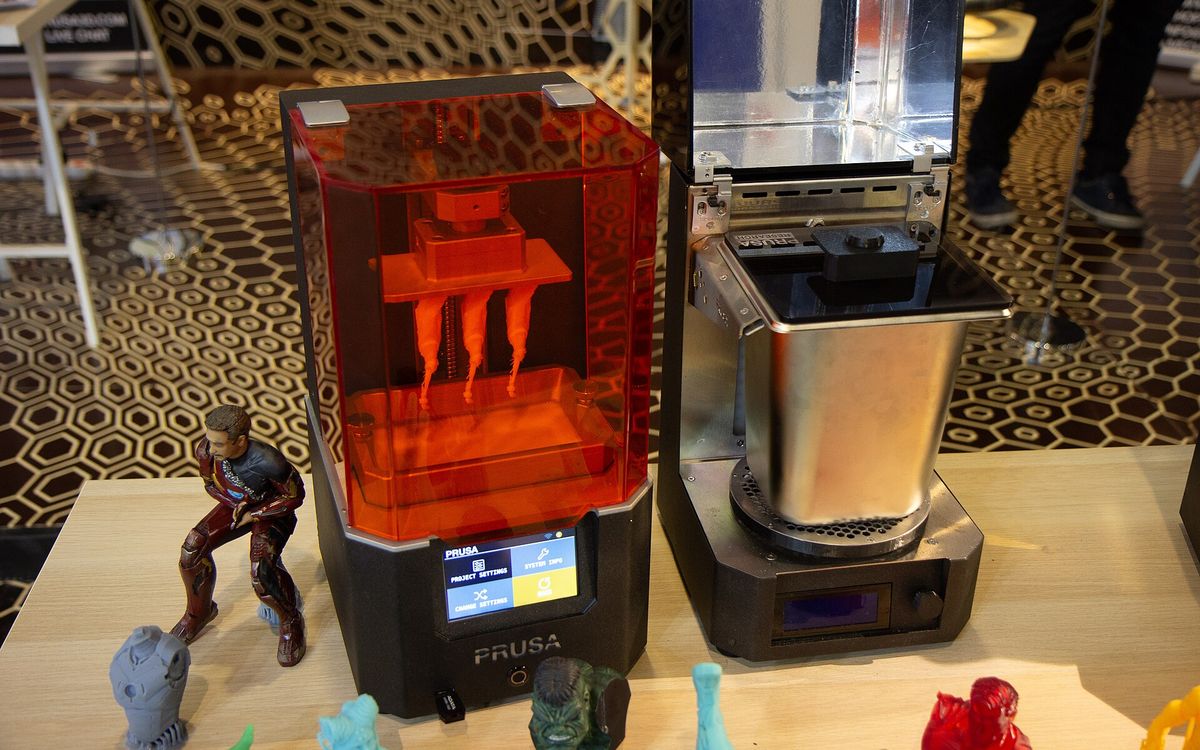
Resin printing gives the finest detail you can get on a desktop machine, with layers down to 0.05 mm. It also involves a liquid chemical that needs more care than a spool of PLA. None of it is difficult, but the habits matter, because the main risk builds up slowly over repeated exposure.
If you are still deciding between the two technologies, start with FDM vs resin for beginners.
Why uncured resin needs respect
Standard photopolymer resins contain acrylate monomers and photoinitiators. In liquid form they are skin irritants and, more importantly, skin sensitisers. Sensitisation means your immune system can learn to react to the resin after repeated contact. Many people handle resin bare-handed for months with no problem, then develop an allergic rash that returns every time they touch it, sometimes even near it. Once sensitised, it usually does not go away.
The practical rule: treat liquid and partially cured resin as something that never touches skin.
Fully cured resin is far less of a concern for handling, but it is still not food safe, and sanding dust from it should not be breathed in.
Always read the safety data sheet (SDS) for the specific resin you use. Formulations differ, and the SDS is the authority for that product.
Protective gear
- Nitrile gloves. Not latex or vinyl, which resin and IPA can get through more easily. Change them when they get resin on them, and take them off before touching your phone, door handles or tools you use bare-handed.
- Safety glasses. Resin can splash when you pour it or scrape a build plate, and IPA in the eye is painful.
- A respirator with organic vapour cartridges is a good idea if the printer is in a small room without good airflow, or if you notice you are sensitive to the smell.
Ventilation and workspace
Resin and IPA both release vapours. Even low-odour resins still emit volatile compounds. Print in a room with fresh air moving through it, not a bedroom or a closed cupboard. An enclosure with an exhaust fan or carbon filter helps but does not replace room ventilation.
Set up a dedicated area:
- Cover the surface with silicone mats or disposable paper so spills are easy to clean.
- Keep food and drinks out of the area.
- Keep children and pets away from the printer, the resin and the wash containers.
- Resin prints most reliably at room temperature, roughly 20–30 °C. Cold resin is thicker and causes failed prints.
If resin gets on your skin
Wash it off straight away with soap and cool or lukewarm water. Do not use IPA or other solvents on skin: they strip natural oils and can help the resin penetrate. If resin gets in your eyes, rinse with clean running water for several minutes and get medical advice. If you develop a persistent rash, stop handling resin and see a doctor.
For spills on the bench, wipe up with paper towels, then clean the residue with a little IPA. Put the towels in sunlight or under a UV lamp until the resin on them is hard before throwing them away.
Washing prints
A print coming off the build plate is coated in liquid resin. It has to be washed before curing, or that coating cures into a sticky, cloudy, uneven surface.
The usual method uses isopropyl alcohol (IPA), ideally 90 % or stronger:
- Let excess resin drip back into the vat for a few minutes with the plate tilted.
- Remove the print with gloves on and a plastic scraper.
- Wash in a first container of used, dirtier IPA to take off most of the resin.
- Wash in a second container of cleaner IPA. A wash station or gentle agitation makes this faster.
- Use a soft brush for recesses and fine detail.
- Let the part dry completely, until no alcohol smell remains. This often takes 15–30 minutes, or longer for hollow parts.
Total wash time is typically a few minutes. Leaving parts in IPA for a long time can make them soft, cracked or chalky, especially thin features.
IPA is flammable. Keep it away from flames, heaters and sparks, keep containers closed when not in use, and do not store large amounts near the printer.
Water-washable resins are washed in water instead, but the dirty water contains uncured resin and is just as unsafe to pour down a drain.
Hollow prints need drain holes. Resin trapped inside a hollow part can stay liquid, build up pressure during curing and crack the part later.
Curing
Washing removes the surface resin. Curing finishes polymerising the part so it reaches full hardness and is safe to handle.
- Use a UV curing station or lamp around 405 nm, the same wavelength most resin printers use. Direct sunlight works too, but is slower and less consistent.
- Cure only when the part is completely dry. Curing a part with IPA still on it can leave a white haze.
- Typical cure times are a few minutes per side, depending on the lamp and the resin. Rotate the part, or use a station with a turntable.
- Remove supports before curing when you can. Uncured supports snap off more cleanly and leave smaller marks.
Do not over-cure. Long exposure makes resin more brittle and speeds up yellowing, especially on white and clear resins. More is not better here. The post-processing guide covers sanding and painting after curing.
Disposing of waste resin and IPA
Never pour liquid resin, dirty IPA or wash water down a sink or drain. Uncured resin is harmful to aquatic life, and it can cure inside pipes.
A common approach:
- Dirty IPA: leave it in a clear, closed container in sunlight or under UV. Dissolved resin cures and settles to the bottom as sludge.
- Pour off or filter the clear IPA on top and reuse it for the first wash.
- Let the remaining sludge cure fully until it is solid.
- Leftover liquid resin: spread it thin and cure it with UV before discarding.
- Cured resin, used gloves, towels and failed prints: once fully hard, dispose of them as solid waste, following your local rules for chemical or household waste.
Storing resin
- Keep bottles tightly closed in their original opaque containers, out of sunlight.
- Store at room temperature, away from heat and frost.
- Shake well before use, because pigments settle over time.
- Filter resin from the vat before pouring it back into the bottle, so cured flakes from a failed print do not contaminate the rest.
Caring for finished resin prints
Cured resin parts have excellent detail but their own weaknesses:
- Brittleness. Standard resin is hard but snaps under impact or bending, especially thin features. It is not a good choice for clips, hinges or parts that flex. Tougher resin blends exist, but for functional parts PETG or ABS on FDM is often a better fit. See the material guide.
- UV yellowing. Continued sunlight keeps reacting with the resin over months, causing yellowing and further brittleness. White and clear prints show it most. Keep them out of direct sun, or seal them with a UV-resistant clear coat or paint.
- Heat. Many standard resins soften well below the temperature of a hot car interior. Do not leave prints on a dashboard.
- Not food safe. Do not use resin prints for cups, plates or anything that touches food, even if the resin is labelled low-odour or plant-based.
If a resin print stays slightly tacky after curing, it was usually washed too briefly or the IPA was saturated. Rewash in clean IPA, dry and cure again. For other resin failures like plate adhesion or suction cups, see common 3D print defects and fixes.
Need it printed?
If you would rather skip the gloves, IPA and waste handling, we print resin parts for fine detail and deliver them washed and cured. Share your file as a Google Drive link with lab@lightning-studio.org, with the size, colour and quantity. More on the Lightning Lab page.
Cover photo: 2018-11-15 Messe formnext Frankfurt 1210 by Olaf Kosinsky, CC BY-SA 3.0 de, via Wikimedia Commons (cropped).
Related posts

3D Printing in Education: A Practical Guide for Teachers and Schools
What to print for teaching, STEM projects students can design themselves, classroom safety, budgeting and a simple lesson flow from sketch to printed part.
Tool Changers vs Filament Swappers: Choosing a Multicolor 3D Printer
Creality K3, Sovol M1D and Bambu's upcoming H3C bring tool changing to mid-range prices. How the five multicolor approaches compare on waste, time and cost.

3D Printing Cosplay Props: Splitting, Finishing and Wearability
How to split big props to fit the bed, key and join the pieces, pick PLA, PETG or resin, keep shells light, then fill, paint and pad them for wearing.